Classical Christian Education Approach for Iliad & Odyssey

This post, Classical Christian Education Approach for Iliad & Odyssey, was made possible with a copy of Iliad & Odyssey Complete Set from Memoria Press for review as part of the Homeschool Review Crew. Affiliate links are present in this post which may net us a commission if you purchase through them.
When planning how to study certain works of literature or time periods, a homeschool parent often spends time discerning the approach.
The question is not whether to read a particular selection, but how to guide your student in their studies.
There are many different styles of learning and even more styles of teaching.
Classical Christian Education is one such method of teaching students.

The Classical Christian Education Approach
In a nutshell, you can describe Classical Christian Education as meditating on the Good, the True, and the Beautiful.
Someone looking at a plan of study for this approach would consider it to be akin to a liberal arts education.
And, they would be right as it employs a blend of linguistic and mathematical skills.
From medieval times, you could see people studying 7 different ‘arts’: grammar, logic, and rhetoric (the “trivium” or linguistic skills), as well as arithmetic, geometry, astronomy, and music (the “quadrivium” or mathematical skills.)
Source texts come from Western civilization, specifically the Greeks, the Romans, and the Christian Bible.
Many programs which embrace the Classical Christian education approach include the study of Latin as a must.
About Memoria Press
Memoria Press has worked hard to develop a curriculum for Classical Christian Education from the early years through high school.
Simplicity, quality, and affordability are the three characteristics of all their products.

While high standards are used when developing their curriculum, they consider that many homeschool families do not have familiarity with the material or approach to learning.
Hence, their desire for simplicity in the curriculum.
They challenge potential customers to seek out similar programs to see just how affordable they are.
Cheryl Lowe founded the company in 1984 “to help promote and transmit the classical heritage of the Christian West through an emphasis on the liberal arts and the great works of the Western tradition.”
The Highlands Latin School in Louisville, Kentucky was begun in 2000 and is now a place to field test the curriculum as it is developed.
Classical Christian Education with Iliad & Odyssey
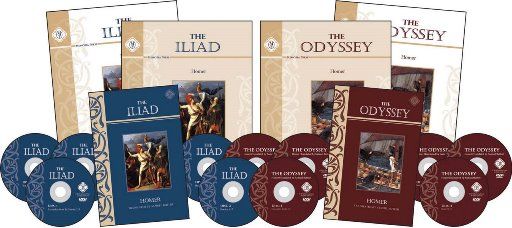
The Iliad and Odyssey are classics from Western Civilization and are found in many programs for study.
They are considered two of the greatest books of the ancient world and were used in classical teaching back then.
Both books were written by the Greek poet Homer are considered epics.
In the Iliad, you read about the great Trojan War and the struggles of the ‘god-like’ Achilles.
The Odyssey is about the man, Odysseus, and his long journey home after the war.
The program of study from Memoria Press is considered appropriate for grades 7 – 12. If you look at their full classical core curriculum programs, these books are presented in the 8th grade.
Within the set, there is a print copy of the book, a student guide, a teacher guide, and a DVD set.
For those who like to read on an electronic device (or use a text-to-speech feature for a child who struggles with reading), there is an ebook format available to purchase. The translations of Samuel Butler are used for the texts because of their accessibility to younger students.
Using This Program
As we have used other materials from Memoria Press in the past, the set up of the curriculum is familiar to us.
Some might say it is guided through a workbook approach as the student completes pages as they progress through the books.
Past reviews for Memoria Press include:
D’Aulaires’ Greek Myths Set
The Book of the Ancient Romans Set
Latina Christiana I & Famous Men of the Modern Ages
Seventh Grade Literature Guide Set
Progression of Work on Iliad & Odyssey
The student guide presents a combination of vocabulary, discussion questions to assess what they are learning, and projects or writing assignments to take the learning further.
Within the teacher guide are the answers to the student guide’s work as well as quizzes and tests.
What I find really makes this program shine, is the DVD set of teacher lectures. The first session is meant to be watched before beginning the books. Then, subsequent sessions are watched as you complete each lesson.
So, after that initial viewing, the progression of work by the student is to:
read the section of text assigned
complete the student book pages
watch the video for that lesson
make any needed adjustments to your written work
turn it all in
and then start on the next section of reading (the cycle begins again!)
I call this the lather, rinse, repeat pattern of work.
Depending on your student’s abilities and motivation, the pace is easy to individualize.
Each of the texts is meant to be done in a semester. So, you can divide up the lessons across the weeks of study for a base.
However, the more driven student may finish in less time.
Our Family’s Thoughts on this Program
While I have boys who are more driven to get work done so they can play video games or read books, they are all different in styles of learning.
My 8th-grade son is the one who has been working on this material for the review. He told me that he wished more of his work was the lather, rinse, repeat with workbooks to fill out.
For the review period, he has been walking through The Iliad. Even though you could start with either book, he is definitely one for going ‘in order.’ Since The Iliad chronicles events before The Odyssey, his choice was simple.
I think what he really likes is that Memoria Press has broken it all down into small bites.
Some of the literature-based work we’ve done in the past is more fluid in its approach.
The learner in me thrives on a fluid approach with the opportunity to have lengthy discussions on a concept or topic after reading the complete work.
However, he prefers the fill in the blank style to get the work done.
That being said, I can see from answers that he often tries to take the ‘quickie’ approach to his responses. But, that just opens up the opportunity to make him dig deeper.
A Favorite Part: The Video Lectures
What I loved as a parent were the video lectures on DVD. I had him watch in the room with me.
Even though I stayed busy with other work, I was listening to much of the lecture. This way I could learn more alongside him and ensure this part of the work was done.
We found that some of the lesson questions that puzzled him were often addressed in the lectures.
Why a program with recorded lectures?
They benefit from a teacher who is truly immersed in the material.
An added benefit is that someone other than mom or dad shares their knowledge.
As the boys have matured, I find this very useful for their studies.
It may not be quite the same as attending a lecture in a classroom, but it provides the best of that experience.
Have you tried Classical Christian Education in your homeschool?
Did it work well for you?
Don’t just take my word for how we found this to be. Visit Memoria Press #1 Reviews on the Homeschool Review Crew website to see what other homeschooling parents thought about this book.

Is this curriculum appropriate for a mildly dyslexic child?
Thank you for your review.