Nuggets of Wisdom from Dr. Ben Carson Presentation

Dr. Ben Carson. A name that many with a connection to neuroscience and neurosurgery recognize.
And for some Americans, a retired physician they remember as someone who ran in the Republican primaries for the 2016 election. Then he served as the 17th United States Secretary of Housing and Urban Development from 2017 to 2021.
This post compiling nuggets of wisdom from Dr. Ben Carson was made possible by my attending his presentations at Pearl River Community College on Oct. 5, 2021. I took copious notes as part of my job to cover the event with only some of the material included. This contains more of Dr. Carson’s thoughts and my own reaction to his presentation. All opinions in this piece are my own.

Excitement for the Presentation
Back in the spring of 2021, my third son and I made the rounds at an afternoon event on the Pearl River Community College campus in Poplarville, Mississippi. He was already a dual-enrolled student there and planned to enter as a freshman in the fall. The visit was more to get a few nagging questions answered, including information about the Honors Institute.
While chatting with the director of that program, we learned that the speaker for the fall 2021 lecture series was Dr. Ben Carson.
This gal was all “sign me up!” to hear him talk as I recalled my few years when I studied neuroscience.
Fast forward a few months and not only was I going to have a front-row seat with my son at the presentation, but also be given the opportunity to sit in the question and answer session with the honors students. A privilege, really.
Dr. Ben Carson Speaks to the Public
When he was introduced to the assembly, they broke out in applause and gave him a standing ovation. There was a lot of excitement in the room.
And Carson set the tone for the next hour when he said “I am not politically correct.”

He then took the audience on a journey through parts of his life with his own opinions and words of inspiration, motivation, and wisdom scattered throughout the presentation.
He walked through growing up in a single-parent household.
Moving from Detroit to the Boston area and then back to Detroit.
His struggles with school and anger.
His mother’s assistance upon both he and his brother reading each week.
His love of things surrounding medicine.
A few key moments from medical school and his time as a neurosurgeon.
And with the quotable snippets, he wove in both his strong faith and his conservative political views.
Carson’s Boyhood Struggles
He glossed over parts of his early childhood aside from mentioning that his parents divorced. How his mother had minimal education and worked in domestic positions.
That it was his mother’s observation that the wealthy read a lot of books and watch little TV; the flip opposite of the other poor they knew.
He shared two stories from his youth that were pivotal for him.
First, was sitting in his 5th-grade class with the teacher holding a black rock while asking who knew what it was. Up until then, Carson’s classmates considered him a ‘dummy’ and he didn’t disagree. But, he was already reading books on subjects that interested him, especially about animals and nature.
He watched and noticed that none of his classmates were raising their hands. So, he did and surprised everyone when he correctly identified the rock as obsidian and then talked about it. That was when he went from being a ‘dummy’ to a ‘bookworm.’
The second time was as a teen when he tried to knife another teen in the stomach. The knife hit the belt buckle and Carson realized that his anger was getting the better of him. That with his temper and outbursts he was looking at reform school, jail, or the grave if nothing changed.
He dug into Scripture and realized that those moments of acting out were from a place of selfishness. That he was considering life was always about him and not others. That epiphany led to a dramatic shift away from the anger and tendency towards violence.
“When God changes your heart, he doesn’t do a paint job,” said Carson. “He fixes it for good.”
College, Medical School, and Life as a Neurosurgeon
Carson was blessed with a seat and scholarship to attend Yale University. Looking back, he said that the best thing about going to Yale was meeting his wife, Candy. Surprisingly, they were both from the Detroit area but didn’t meet until they were both at Yale.

He then went on to say how different it is there now. That Yale and so many other universities and colleges “have become indoctrination mills.”
After Yale, he went to The University of Michigan School of Medicine. He struggled with his studies and was advised to give up on his dream of being a doctor. Instead, he stopped going to lectures and dug into books.
From the age of eight to thirteen, Carson thought he wanted to be a missionary doctor. When he realized they didn’t really make much money, he shifted his sights to psychiatry. But, when he was in the midst of his studies he found himself attracted to the physical aspects of the brain.
When he entered the field of neurosurgery, he was one of only eight black neurosurgeons in the world.
But, as he reminded the audience, “God doesn’t pass out talent based on color.”
Carson shared a story from his time as a resident at Johns Hopkins. A patient came in at a time when most of the department was at a conference. The attending physician wasn’t responding and he had to find the courage to make a tough choice. He could do nothing until the attending arrived and the man would most likely die. Or, he could perform a procedure without the attending present and the man might live.
It worked in their favor and the man survived while Carson was congratulated. Yet, shortly after this experience, he realized he had a “big head” and was forgetting who is really in charge. That it is God doing it all, not me. And, that God will participate in any of our lives when we recognize Him and His hand.
This realization had Carson surrender in prayer, “You be the neurosurgeon, I’ll be the hands.”
Remember THINK BIG to Guide Your Life
Carson wrote a book THINK BIG that covers this approach to living your best, authentic life. Our, as he coins it, a formula for success.
Talent
Honesty
Insight
Nice
Knowledge
Books
In-depth learning
God
A few explanations of those key points from my notes:
Honesty means having no skeletons in the closet. If they aren’t there, there is nothing to come back and haunt you.
Insight means learning from someone else’s mistakes rather than having to make them all yourself.
Knowledge is the way you can become a more valuable person.
In-depth learning is done for the sake of knowledge and understanding.
Reflecting Upon Our Country and It’s Future
Midway through his presentation (right after talking about Yale), Carson diverged off into what bordered on the political.
He started with a slam against universal masking requirements. Saying that it impedes facial cues for young children still learning to match them with the verbal statements.
Or that school-aged children are being told they could be responsible for killing a grandparent because of a virus.
That we need to defend the children while preserving the country and our freedom.
Because governments are going to do what governments do (grow, infiltrate and control.)
Our country is of the people, by the people, and for the people.
Yet, courage is sometimes lacking in our society. People avoid confrontation instead of getting involved.
His talk finished up with the reminder that we are not each other’s enemies.
That we must be willing to help each other in the community.
That we must make a choice of what kind of people we’ll be.
Finally, when we next listen to The Star-Spangled Banner with a hand over our heart, to remember that we can only be the “Land of the Free if we are the home of the brave.”
Snippets from the Honors Institute Visit
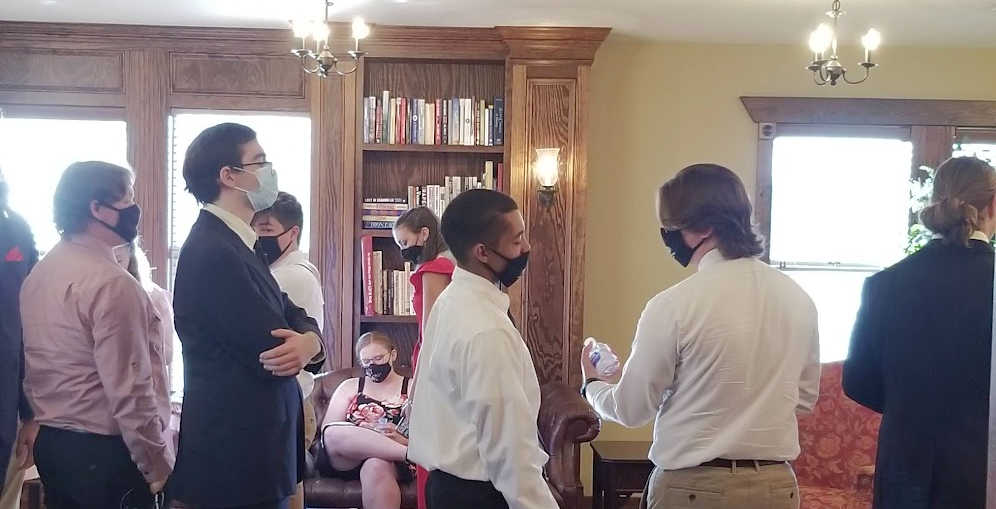
Some of what he covered overlapped with what he shared in the public presentation.
However, it was run more as a question-and-answer session.
After the group portion, students were given the opportunity for one-on-one time.
Advice for Students Pursuing a Career in Medicine
He started off by saying to know HOW you learn.
He did not learn well through lecture courses, but he did well with reading the material.
He also used flashcards to help with repetition.
While his advisor had told him to give up, he prayed for wisdom and then hunkered down. Looking back, he sees this as an example of a person focused on why something can’t be done.
Physician burnout is something that was asked about, but he has not experienced it.
Carson believes that some may put too much pressure on themselves.
Rather, stay focused on doing your best and recognize that not everything is your problem.
Finally, rely on God.
How to Stay Strong in Faith
Carson said that bad things will happen.
Leaning into his faith helps make him strong for the adversity being faced.
As an example, he talked about becoming the 17th United States Secretary of Housing and Urban Development.
He expected a cesspool in D.C. and that environment did not disappoint.
He talked about the $31,000 dining room set scandal and how the investigation into whether there was wrongdoing cost taxpayers close to one million dollars.
That in our society (especially in politics), there is too much focus on digging up dirt.
Many in his generation have a “my way or the highway” philosophy. Today’s young adults need to push things forward.
The current parties have distinct and opposing views. One emphasizes the individual above all else while the other wants the government to control everything so they can take care of the people from cradle to grave.
It will be through the power of their vote that the American people will decide what path the country will go on.
Recommended Books to Read
The question was asking for favorite classical literature and books for the medical field.
The response led with The Bible, especially the Book of Proverbs, being his most recommended title.
He shared the story of the black rock in fifth grade.
But, he also elaborated on how that event helps him realize he was the person most in charge of what happened to him.
Reading had a profound impact on who he became. It was because of it that he could rise above the poverty he hated.
Plus, true readers are more creative.
Advancements in Neurosurgery
One student asked about the potential for surgical intervention surrounding vision loss.
Carson reflected on the amazing advancements in neurosurgery from when he entered the field.
He referenced TV shows that some of the students had probably never heard of before.
The Six Million Dollar Man and The Bionic Woman seemed like science fiction at the time.
But, many of the surgical enhancements done in that show are becoming possible now.
Why Not a Veterinarian
The final group question asked him why he became a physician and not a veterinarian.
After all, Carson admits he loved learning all about animals as a youth.
His off-the-cuff response?
He was afraid an animal would bite him.
This did lead to an interesting explanation of the differences between the human brain and that of other animals.
Basically, humans have a much larger frontal cortex that allows for rational thought.
Animals have bigger midbrains which is connected to the ability to react.
He then closed with a reference to Dr. Martin Luther King, Jr. calling for us to judge on the content of character. This is something people can do rather than react to a physical characteristic (e.g. skin color.)
My Thoughts on the Dr. Ben Carson Visit
First off, Dr. Ben Carson is a very soft-spoken individual.
He may say things that get people cheering, but you have to be quiet to hear what he is saying.
Regardless of your own political tendencies, I found this a wonderful opportunity for those who attended. To have someone with national recognition come to a community college in small-town Mississippi is a big deal.
Where we live in southern Mississippi, the people lean more conservative.
This was evident at his presentation with plenty of clapping when he said something showcasing his faith or his conservative political views.
Personally, I am independent as I do not align with any one political party and have not for decades. I do like to hear the different sides and then vote my conscience.
Depending upon how you listened, some of what he said could be heard differently.
A conservative in the room hears the call to have courage and stand up for your beliefs as a call to support the Republican Party.
But, for me, I heard it as knowing your beliefs and values and not being afraid to stand up for them.
As a person of faith, I always appreciate when a public figure talks openly on their journey with the Lord.
And I definitely respect someone who pushes the importance of reading and learning for life.
My love for learning and reading probably played into my decision to homeschool the boys.
Finally, I am all for living with others in mind and recognizing that those who think differently than us are NOT our enemies.

Things I Wish He’d Talked More About
When you are trying to keep a presentation under an hour, I recognize choices have to be made about what to say.
Dr. Carson was not working off a script, but rather appeared to go off the cuff.
Although, I would suspect he’s done enough of these talks that he has a set framework.
Carson Scholars Fund
Something that was not really touched upon is the Carson Scholars Fund that has been around for 25 years. They provide scholarships to students in grades 4 to 11 as nominated by a teacher or administrator from their school. Those scholarships are then used to attend a four-year school.
Part of the Carson Scholars Fund is their Reading Rooms program. Reading played such a big part in Dr. Carson’s ability to rise above the poverty he knew. The Reading Rooms seek to offer that hand-up to other students as well.
His Surgical Career
He did touch a bit more on it in the Q & Ad session with the honors students.
But, far less was mentioned in his public presentation.
I’ll admit the desire to hear more about the groundbreaking surgeries he’s performed might have stemmed from my own time studying neuroscience in graduate school.
So there you have it.
All my notes pulled together as well as a few of my thoughts.
Have thoughts to add?
Comments are open below. Keep them polite or it will be removed.