Irena’s Vow: A Testament of Courage
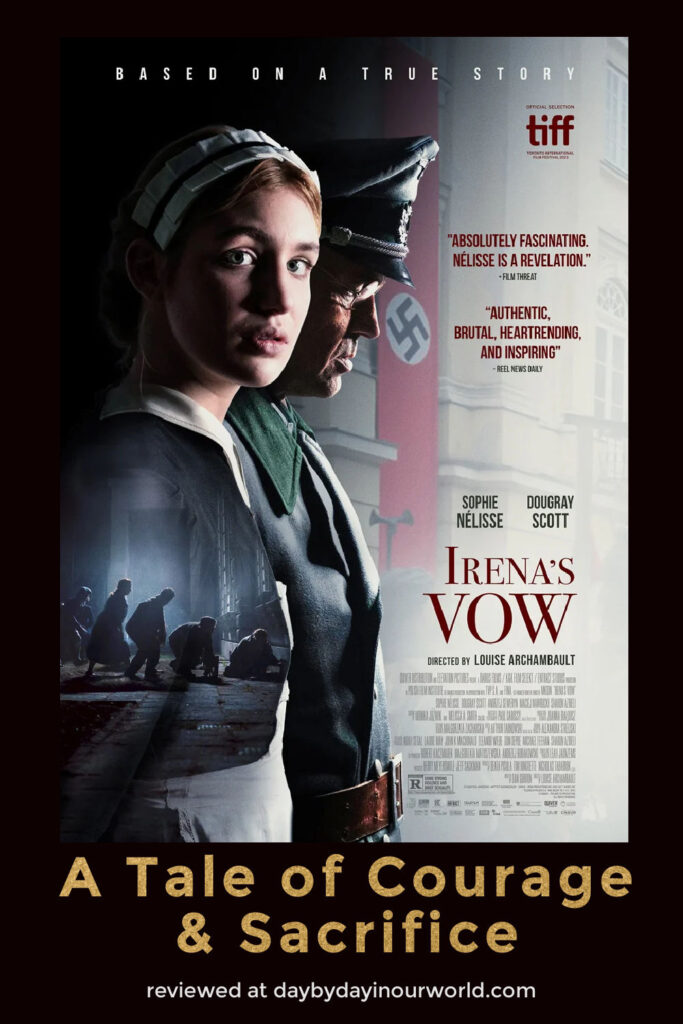
“Irena’s Vow” introduces audiences to Irena Gut, an unsung hero of World War II whose bravery shines through as she risks everything to save Jews from Nazi persecution. Learn more about Gut’s incredible journey in our review of the film.
I am no stranger to watching a good faith-based movie or historical drama. Sometimes the two genres merge, as in the film Irena’s Vow.
In this film, we jump back to the days of World War II. This is a period that many of us keep revisiting in books and movies.
There is something so compelling about stories of that time. Maybe it is the reminder that man is capable of truly evil deeds. Or we recognize that good people can be driven by self-preservation to stand by and watch atrocities committed.
Irena’s Vow tells a new story from the war — one in which the protagonist decides to not merely keep herself safe, but to aid a few others in the process.
Irena’s Vow has a limited theatrical release through Fathom Events on April 15 and 16, 2024. Find a theater near you and purchase tickets.

Irena’s Powerful Story
The brief synopsis you’ll find is this:
“Through the eyes of a strong-willed woman comes the remarkable story of Irena Gut, and the triumphs of the human spirit over devastating tragedy, as she risked her life to save a generation of Jews from the atrocities of the Holocaust.”
I’ll expand a bit more on the storyline.
From Nurse to Servant
At the start of the film, young Irena is working in a Polish hospital as a nurse. There is a blast on the hospital ward and a stunned Irena walks towards her home. She finds the name placards of streets being changed to German names and her home has been taken over by a German officer. She has no idea where her family has gone.

The nod to Irena’s faith as a Catholic comes as she sits in Mass. While standing in line to receive Communion, she is rounded up with other Poles and forced to work in a plant.
There is a jump in time when she is working in that industrial setting. She starts to pass out one day. That catches the eye of Wehrmacht Major Eduard Rügemer who takes her on for service at a hotel that frequently served Nazi officials.
This is when the story introduces a dark side of the war — the Nazi treatment of Jews as sub-human. They would use them up as workers, not caring if it drove them to death. Even worse was the racial cleansing that soon entered that section of Poland. Irena witnessed a German soldier rip a baby from its mother’s arms to throw it onto the street, killing the baby (in the film he stomps on it) before killing the mother.

This moment of horror was so significantly impactful for Irena that she ultimately made the vow to herself to do what she could to save a life.
While at the hotel, she overhears conversations of impending doom that will befall the Jews. She passes along word with the hopes of saving some of them.
Taking Action to Save Lives
Then, Major Rügemer tells her she will become his housekeeper, managing a villa where he will now reside. It is then that she helps a dozen Jews hide in his cellar.

There are additional twists and turns in the film.
Someone leaves a note accusing her of hiding Jews and demanding a ransom. That potential whistleblower gets dealt with creatively.
One of the women in hiding becomes pregnant. They request that Irena procure the tools needed for an abortion. She refuses and encourages the woman to have the baby.
Then, one day Irena forgets to lock the main door and the Major walks in on her with three of the women. He agrees to keep her secret if she willingly becomes his mistress.
The film then quickly moves through the retreat of the Germans, the occupation of Poland by the Russians, and Irena’s need to flee the country.
Trailer for Irena’s Vow
My Thoughts on Irena’s Vow
When I saw the opportunity to review the movie, I almost passed it by. However, when I learned more about Irena’s experience, I felt compelled to do so.
My godmother is from Poland. Her parents lived through the war, eventually emigrating to the United States in the 1950’s. I do not recall them ever speaking of that time, but I imagine they had plenty of stories to tell.
Many who lived through that time avoided speaking of it as the pain was so great. Irena’s own story might have been left untold if it wasn’t for a neo-Nazi claim that the Holocaust never occurred.
Like Irena, my godmother’s family and my own are Catholic. We share a common faith and belief system. That was the second tidbit that drew me to watch the film.
Overall, I really enjoyed the film and found it well done.
They filmed in Poland, lending it authenticity while showcasing some of the country’s beauty.
The actors made the scenes believable, even the one where the baby and mother are killed. There are a few more violent scenes, but not too many. Even times when sex occurs, there is not any visualization of the actual acts. The audience gets what happens without having to see it.
Rather, the movie focuses on what Irena sees and how she responds — how her faith drives her actions, even when fearing for her own life.
I highly encourage anyone who enjoys faith-based films or historical films set during World War II to see this film. Since it is not overly graphic for sex and violence, the film could be viewed by middle and high school-aged children. However, the material does have the potential to be disturbing to some. I use those as teaching moments for my boys as I’d rather them know how people have done and will continue to do evil acts in our broken world.
Sometimes the Truth is Almost Unbelievable
If the story touches you and you’d like to learn more, you can read the book In My Hands: Memories of a Holocaust Rescuer written by Irena (Irene) Gut Opdyke. The reading recommendation is for grades 7 and up.
There are several sites with interview material, sometimes with photos.
- PBS Frontline
- The Zekelman Holocaust Center
- Don’t Be A Bystander
- Echoes and Reflections
- Polish Righteous – Stories of Rescue
- Achuka – January 2001 Interview
- Rough Draft Atlanta – Conversation with Irena’s Daughter
Here are a few videos of interviews with her or her daughter: